Responsibility Without Control
Every clinician carries a case that doesn't let go. What these moments reveal about responsibility, uncertainty, and the stories we tell ourselves after the fact.
A Lesson from the Labor Ward
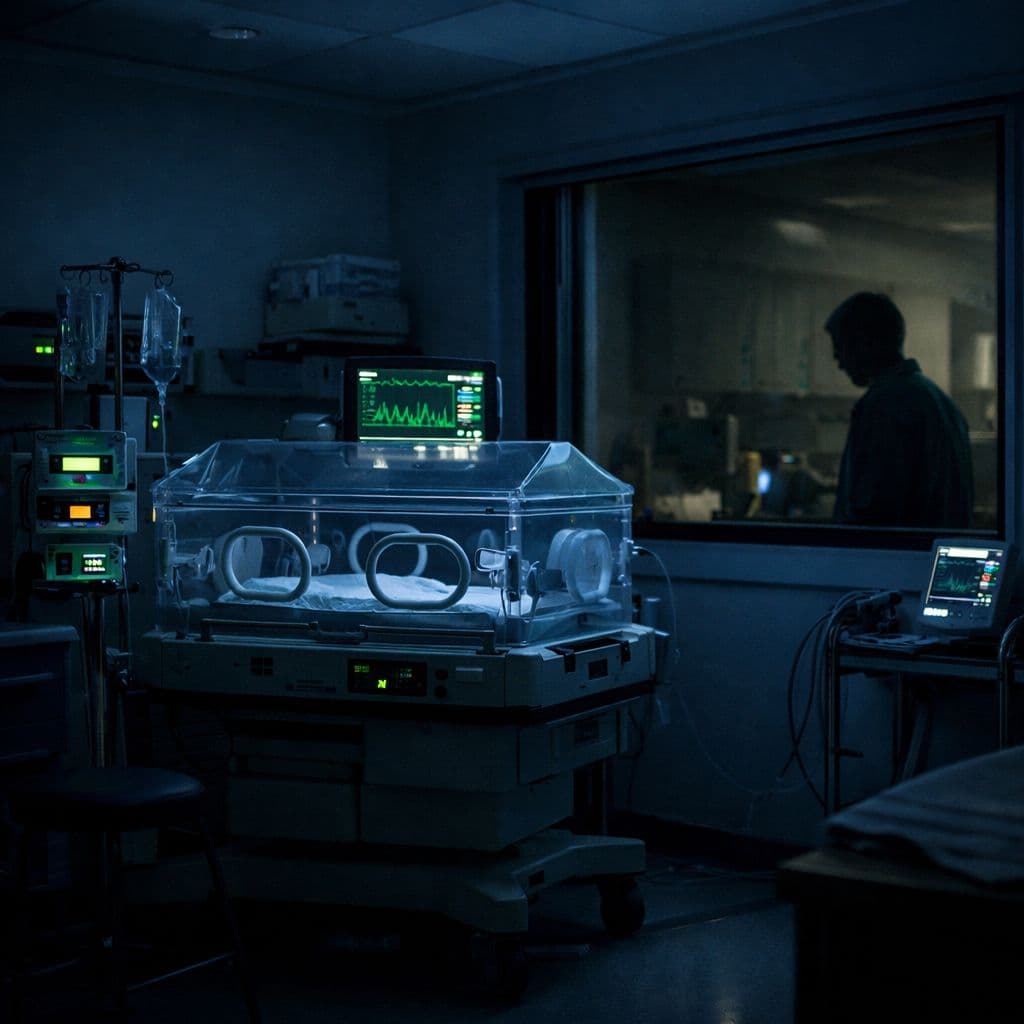
In my first week of neonatal intensive care as a resident, I was covering the labor ward in a district hospital in London. I remember being terrified of 'flat babies', especially those born at night, with few senior people around. The first moments after a complicated delivery, when the baby comes out blue and motionless, and everyone looks to you.
Most of them, fortunately, follow a familiar pattern. A bit of stimulation, some positive pressure, and within seconds to minutes they pink up and cry. The experienced midwives carried a calm confidence that I lacked. They had seen this thousands of times. They knew how these stories usually ended.
On one particular night, I was working with a midwife I had come to know well over those first weeks — warm, composed, and entirely unflustered. But this baby was different.
He didn't respond the way he was supposed to.
I remember the growing unease as the usual steps failed to produce the usual response. I became increasingly anxious, my hands less steady than they should have been. I struggled with the intubation. I bagged, tried again, watched the saturations refuse to rise in any meaningful way. Time seemed both compressed and stretched.
My registrar arrived, intubated successfully, and took over. The baby was transferred to the neonatal unit.
He died within 24 hours.
No post-mortem was performed.
This one didn't follow the script.
The Part That Stays
In the days that followed, I had many conversations with senior colleagues. They were kind, measured, and reassuring.
- 'A term baby shouldn't behave like that.'
- 'It wasn't you.'
- 'There was likely something fundamentally wrong — pulmonary hypertension, perhaps something rarer.'
They were probably right.
But that wasn't the version of events that occupied my mind.
What stayed with me was not the most likely explanation, but the most uncomfortable one: What if this was, in fact, on me?
I replayed the scene repeatedly, not just as it happened, but as it could have happened. Faster hands. A cleaner intubation. A different sequence of decisions. A better outcome.
I wasn't replaying the case — I was rewriting it.
It took weeks before those thoughts began to loosen their grip. Sleep was patchy. A few nights, I caught myself drinking alone — less for the drink itself, more to take the edge off the constant replay.
A Familiar Story
Every doctor carries cases like this.
They differ in detail, in severity, in how early or late they occur in one's career. But the structure is similar: a moment where something doesn't go as expected, followed by a lingering question that never quite resolves.
With time, these memories tend to soften. They occupy less space, surface less frequently. But they do not disappear.
And experience does not eliminate them. If anything, as responsibility grows, so does the weight of these moments. The decisions become more complex, the stakes less abstract.
Doubt does not disappear with experience — it becomes more familiar.
The Uncomfortable Truth
Medicine trains us to think in terms of control.
We learn physiology, protocols, escalation pathways. We are taught that if we recognize patterns early enough and act correctly, we can influence outcomes. Much of the time, this is true.
But not always.
There is a quieter, less discussed reality: we often carry full responsibility for decisions made under conditions where control is, at best, partial.
Biology is not fully predictable. Not every pathology declares itself clearly. Not every patient responds as expected. And not every outcome can be traced back to a single correctable action.
This creates a tension that is difficult to resolve.
On the one hand, you cannot abdicate responsibility. The decisions are yours, and they matter.
On the other hand, you cannot claim full control over the outcome.
The Illusion of the Perfect Alternative
In the film *Sully*, Captain Chesley Sullenberger lands a passenger plane on the Hudson River after both engines fail shortly after takeoff. The outcome is extraordinary — no loss of life.
What follows is less often remembered.
Investigators, aided by simulations, argue that he could have made it back to an airport. The implication is subtle but powerful: a better decision might have existed. A cleaner, more optimal path.
But the simulations assume ideal conditions — immediate reaction, no hesitation, perfect information. They remove the very elements that define real-life decision-making: uncertainty, time pressure, human limitation.
Only when these factors are reintroduced does the conclusion shift. The 'better option' was, in fact, never truly available.
Medicine is full of similar retrospective narratives. Looking back, there is often an apparent alternative — a decision that seems, in hindsight, more correct, more skillful, more decisive.
But hindsight edits the scene. It removes the ambiguity, the noise, the incomplete data. And in doing so, it quietly raises the standard to something that may never have been achievable in the moment.
How Not to Cope
1. Over-responsibility — To internalize everything; to assume that a different action would have led to a different outcome. Over time, this erodes confidence, increases anxiety, and makes future decisions more hesitant.
2. Detachment — To attribute outcomes entirely to disease processes, bad luck, or system factors. This protects you in the short term, but risks blunting the very sense of responsibility that underpins good clinical care.
Both positions are psychologically convenient — one preserves a sense of control, the other protects from blame — and clinically dangerous.
A Narrower Path
Somewhere in between is a more demanding position.
You accept that you are not in full control of outcomes. But you hold yourself accountable for the process by which decisions are made.
- Did you think clearly?
- Did you seek help early enough?
- Did you consider the relevant possibilities, even under pressure?
- Did you act with the level of care you would expect from someone else in your position?
These are not easy questions to answer, especially in retrospect. They rarely yield certainty.
But they shift the focus from outcome to integrity of decision-making. It is a subtle shift, but an important one.
Looking Back
When I think back to that night, I still cannot say with certainty what would have happened had those first minutes unfolded differently.
It was my first real encounter with the limits of control — and how personal they can feel.
Those encounters do not disappear. They return, in different guises, throughout a medical career. They do not become easier. But they become more familiar.
Good medicine is often practiced in the presence of doubt, and the 'better outcome' we imagine afterward may never have been fully within reach.
But uncertainty is not a shield. It leaves us with the uncomfortable obligation to revisit how we thought, decided, and acted — knowing we may never arrive at a definitive answer.